
TL;DR
Open car haulers cost less, weigh less, and load faster. Enclosed car haulers protect against Pacific Northwest rain, road grime, and theft, and they hold their resale value better. Pick enclosed if you're hauling year-round in Western Washington, transporting a classic, race car, or daily driver, or storing the trailer outdoors. Pick open for occasional summer moves and weather-flexible hauling on a tighter budget.
We first published this guide in early 2025 and refreshed it with current pricing on the Bulldog lot and Pacific Northwest weather data. We're a family-run trailer dealer in Chehalis, Washington — 30 years on the same Lewis County lot. Open vs enclosed is the question we get most on the car hauler floor, so here's the answer the way we'd give it if you were standing across from us.
Car hauler vs. enclosed trailer: what's the difference?
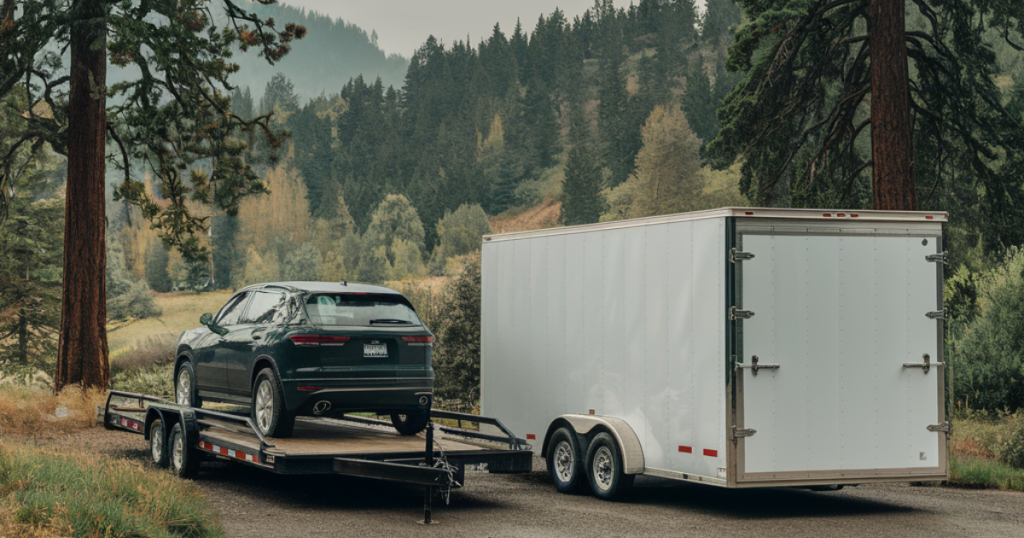
A car hauler is a flat-deck trailer purpose-built to load and tow a vehicle, usually 16–28 feet long with reinforced ramps, integrated tie-down points, and an axle setup matched to vehicle weight. The deck is open to weather. An enclosed car hauler is the same trailer wrapped in steel or aluminum walls and a roof, with a rear ramp door and usually a side access door. Both are car haulers. The difference is the box.
We carry both. The Bulldog floor stocks our in-house Bulldog open and enclosed builds, Big Tex open haulers, and Continental Cargo enclosed car haulers in deck lengths from 18 feet up to 28 feet, with longer enclosed and gooseneck units on order. If you're shopping in Lewis, Thurston, Pierce, or Cowlitz county, you've probably already passed our lot on I-5.
When should you choose an open car hauler?
Open is the right call when price, payload flexibility, or maneuverability matters more than weather protection. Concrete cases we see weekly:
- Local moves, summer weekends, occasional use. You're driving a project car to the shop, hauling a tractor home from auction, or moving a daily driver across town.
- Tight tow vehicle. A 7K open hauler weighs 1,800–2,500 lb empty — roughly 1,500–2,500 lb less than a comparable enclosed. That keeps you well inside half-ton and three-quarter-ton tow ratings.
- Loading flexibility. No roof means no clearance limit. You can stack items on the vehicle, haul a truck with a roof rack, or load equipment that wouldn't fit in a 7-foot enclosed box.
- Lower upfront cost. Open car haulers run roughly 30–50% less than the comparably-sized enclosed in our market. Specific bands are in the cost section below.
If you only haul a couple of times a year, store the trailer in a barn, and the cars you pull are insured-replaceable, open is almost always the right answer.
When should you choose an enclosed car hauler?
Enclosed is the right call when the cargo or trailer is valuable enough that weather, theft, or road damage would actually hurt. Four patterns:
- High-value vehicles. Classics, restorations, race cars, performance daily drivers. Salt spray on I-5 in winter, gravel kicked up by traffic, and the inevitable Pacific Northwest horizontal rain add up over a year of open-deck hauling.
- Year-round Western WA hauling. If you're moving cars November through April, you're moving them in the rain. Enclosed keeps moisture, road salt, and grit off the vehicle.
- Outdoor storage or theft exposure. An enclosed trailer is also a locked box — protects the vehicle inside and the trailer's wiring, lights, and ramp gates from tampering.
- Mobile workshop or business use. Enclosed haulers double as workshops and weather-tight spaces for race-day tools, which often justifies the cost difference for serious hobbyists and small race teams.
For a daily-driven enclosed hauler, you're typically looking at a 24-foot or 28-foot Continental Cargo bumper-pull, or a gooseneck for one-tons pulling 30-foot+.
How much more does an enclosed car hauler cost?
In our market, an enclosed car hauler typically runs roughly 1.8x to 2.2x the comparable open hauler, depending on length and options. Working numbers as of mid-2026:
| Trailer | Length | Typical price band (Bulldog lot) |
|---|---|---|
| Open car hauler — Big Tex 70-series | 18–22 ft | $5,500 – $9,000 |
| Open car hauler — Bulldog in-house | 18–22 ft | $5,000 – $8,500 |
| Enclosed car hauler — Continental Cargo | 20–24 ft | $11,000 – $17,000 |
| Enclosed car hauler — Continental Cargo | 26–28 ft | $15,000 – $22,000 |
Prices move with steel and aluminum costs and with the option list (extra interior height, finished walls, custom flooring, side door upgrades, electrical packages). Call us at (360) 748-4416 for what's actually on the lot today, or stop in during shop hours — Mon–Fri 9–5, Sat 9–3.
What size car hauler do I need for my vehicle?
Match deck length to vehicle wheelbase plus 2–4 feet of working room. The most common single-car sizes:
- 18-foot — fits compact and mid-size sedans, sports cars (Miata, RX-7, classic Mustang). Tight on a full-size pickup; not enough room for ramps to lay flat with the vehicle on board.
- 20-foot — the sweet spot for most single-car hauling. Handles long-wheelbase sedans, full-size pickups, and most SUVs with a couple of feet of margin.
- 24-foot — long-wheelbase trucks, lifted vehicles, or one car plus a workbench, motorcycle, or pit setup behind it.
- 28-foot+ — typically enclosed, common for race teams hauling car plus pit equipment.
Bring the truck and a tape measure. We'll measure the vehicle on the lot before you sign anything — that's the right way to do it, and it's the easiest way to avoid an expensive mismatch. The pillar page has more depth on sizing, axle ratings, and tie-down geometry: see our car hauler trailers page.
Open vs enclosed for Pacific Northwest weather
Western Washington is the Pacific Northwest edge case that flips the open-vs-enclosed math.
The data: Olympia averages roughly 165 days a year with measurable precipitation, and Western WA west of the Cascades sees on the order of 150 wet days per year per NOAA NCEI 1991–2020 climate normals. That's nearly half the year. October through April, you're going to be hauling cars in the rain whether you planned to or not.
What that means for an open car hauler used year-round here:
- Salt spray from de-iced highways — especially the I-5 corridor and the passes east — settles on the underside of the vehicle every trip.
- Standing water on the deck collects in tie-down points and accelerates corrosion on cheap fasteners.
- A wet ramp surface is a slip hazard during loading; we've watched enough close calls to be opinionated about it.
For an enclosed:
- The vehicle stays dry. Period.
- Lights, wiring, and ramp gates are sheltered. Wiring failures are the most common service issue we see on open haulers older than five years; on enclosed they're a fraction of that.
- Resale holds better. A 5-year-old enclosed pulled from a garage looks like new; a 5-year-old open used year-round in Western WA shows it.
East of the Cascades — Yakima, Tri-Cities, Spokane — the math leans differently and an open hauler stays sensible. West of the mountains, year-round haulers should price-shop the enclosed first and rule it out only on budget.
Should I buy used or new for car hauling?
Both can be right. Used makes sense for occasional, weather-flexible open haulers — the structural design hasn't changed in 20 years and a clean used 18-foot is functionally identical to new. New is usually the right answer for enclosed because the wiring, seals, and door hardware degrade with age; a 10-year-old enclosed has more service surface area than a 10-year-old open.
If you do go used, inspect carefully before you tow it home. Our used trailer inspection checklist walks through the specific points to check on any used trailer — frame, axles, brakes, lights, deck, and (on enclosed) seals, ramp hinges, and door alignment. We'll do a free on-lot inspection of any trailer you're considering, including ones you haven't bought from us.
Frequently Asked Questions
Are open car haulers legal on Washington state highways?
Yes. Open car haulers are legal on all WA highways with standard tie-down requirements: every vehicle must be secured at four points (typically wheel-net straps to D-rings) at a working load limit sufficient for the cargo weight. WSP enforces tie-down compliance on personal hauling and commercial freight alike. Make sure your tie-downs are rated for the vehicle, your trailer's lights and brakes are functional, and your registration is current before you head out.
How much can a 20-foot car hauler tow?
A 20-foot open car hauler typically has a GVWR of 7,000 to 10,000 lb depending on axle configuration. After subtracting the trailer's empty weight (~1,800–2,400 lb), payload runs roughly 5,000–7,500 lb — enough for nearly any passenger car, most full-size pickups unloaded, and most SUVs. The limiting factor is usually the tow vehicle, not the trailer. For the math, see our companion guide on trailer towing capacity.
Can I use an enclosed car hauler for moving household goods?
Yes — enclosed car haulers double as moving trailers and are popular for cross-state moves. The interior is usually 7 feet wide and 6.5–7 feet tall, comparable to a small moving truck. If you're shopping primarily for moving and only occasionally hauling a vehicle, also look at our cargo trailer inventory — those are purpose-built for box-load moving with floors rated for furniture rather than for vehicle tie-downs.
Where can I buy a car hauler in Lewis County, WA?
We're at 151 Labree Road, Chehalis, WA 98532 — about a mile off I-5 at exit 76. Our floor regularly stocks Bulldog in-house car haulers, Big Tex open haulers, and Continental Cargo enclosed haulers in lengths from 18 to 28 feet, with longer enclosed and gooseneck units on order. Call (360) 748-4416 or 1-800-909-4416 to confirm current inventory before you make the drive, especially for specific length or option combinations. We deliver throughout Lewis, Thurston, Pierce, and Cowlitz counties.
Do you finance car haulers in Washington?
Yes. We work with approved trailer-financing partners and most car-hauler purchases qualify for short-form pre-approval — about 10 minutes while you're walking the lot. Pre-approval doesn't lock you in; it just gives you the number to plan around. See our financing page for current options or ask us when you call.
Ready to compare on the lot? See our car hauler inventory or call (360) 748-4416. Mon–Fri 9–5, Sat 9–3, on Labree Road in Chehalis. We'd rather help you pick the right trailer the first time than sell you the wrong one.